The Wild Frontiers
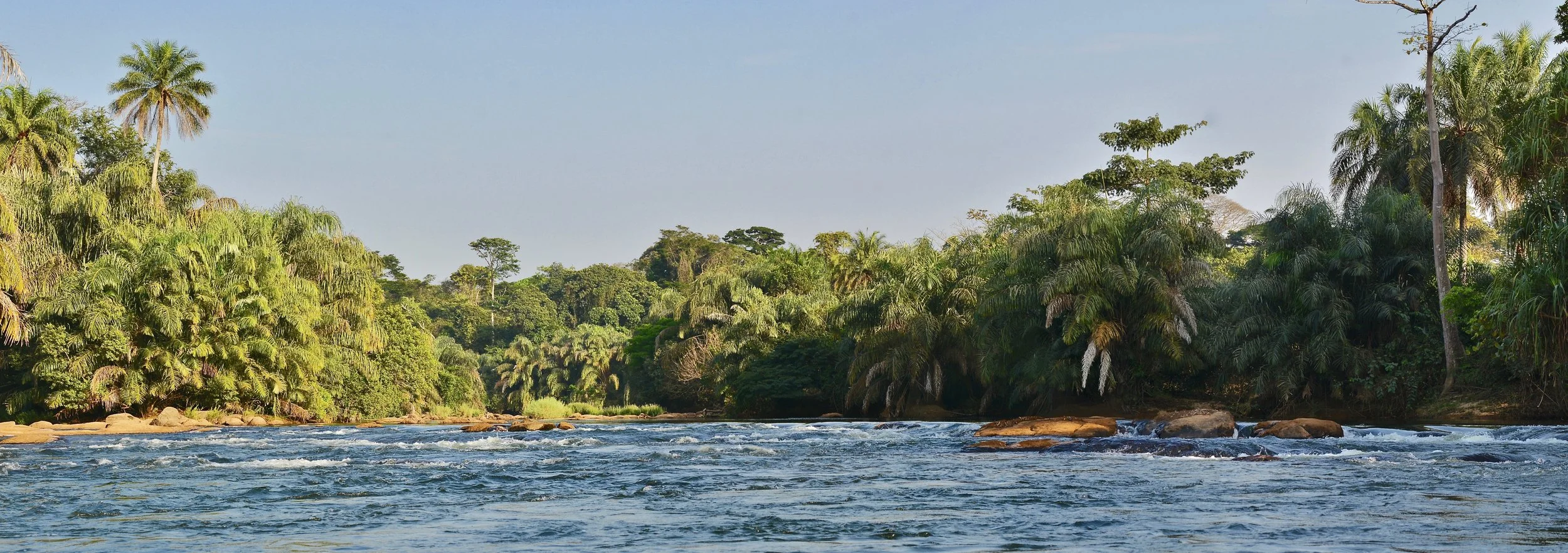
There is a place where the pulse of Africa beats loud. Where dense canopies swallow the light and the air is thick with the sounds of creatures few have ever seen. Tucked into the southeastern corner of Sierra Leone lies Gola Rainforest National Park (GRNP), an ancient “glacial refugium” sheltering species that have survived since the ice ages. It is one of the last strongholds of West Africa's endangered Upper Guinean forests that stretch from the lowland forests in Guinea to the broadleaf forests in Togo. Spanning 71,000 hectares within the Greater Gola Landscape on the Sierra Leone-Liberia border, GRNP remains a sanctuary for rare species, some of which exist nowhere else on Earth. These are the wild frontiers of Gola: unpredictable, untamed, and utterly unfiltered.
“So there’s this rainforest. It’s pretty wild. I think we should go. Meet you at River Number Two Beach?”
I discovered during a chance call with my friend Lucy (from the DRC stories you’ll find on this website) that she was about to set off on the Dakar Challenge, an annual car run from Plymouth, UK, to Banjul, Gambia, that loosely traces old Dakar Rally route.
There were six days to obtain visas for Sierra Leone, Liberia, Côte d’Ivoire and Ghana, but there was just enough time, in theory, to intercept Lucy as she crossed from Guinea into Sierra Leone. This wasn’t the first time Lucy and I had planned like this. She once called me from Senegal asking me to meet her at Abéné Festival just days before New Year. We found a way then, and I was sure there was a way now. So I booked my flights to Freetown and immediately set about making a nuisance of myself at embassies across London. As I boarded my flight, Lucy texted: “So there’s this rainforest. It’s pretty wild. I think we should go. Meet you at River Number Two Beach.”
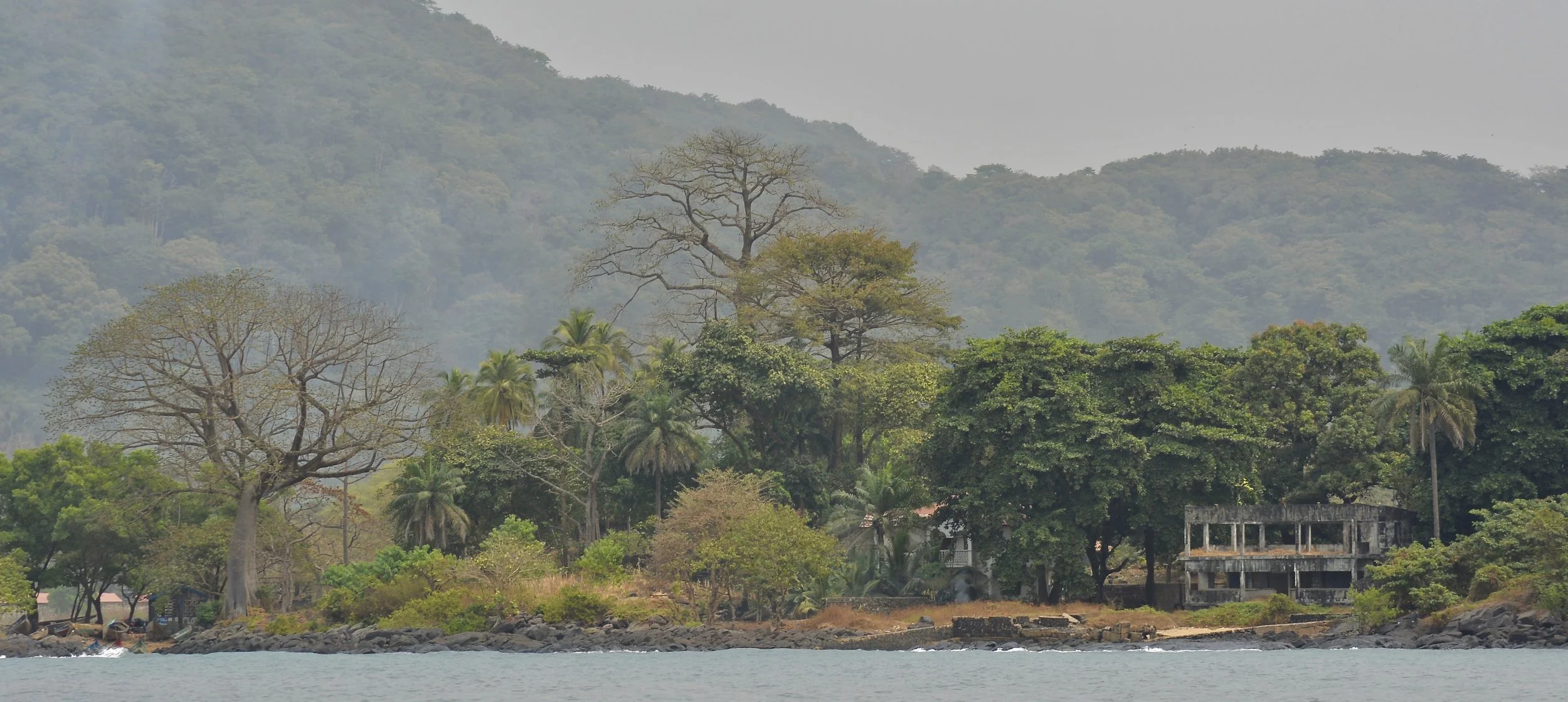
I landed in Freetown in the very early hours. The sun hadn’t even started to rise by the time I passed immigration control. Tired from the journey, all that was left was to run the gauntlet of drivers at Lungi and get south. Freetown was founded in 1792 by freed slaves from Britain and America, their descendants are known as the Krio (Creole) people. It is a port city built around one of the world’s largest natural deep-water harbours. The airport in Lungi is connected to the city via the Kissy-Tagrin ferry across the Sierra Leone River. The harbour and port terminals were lively, even in darkness. I never did get the chance to explore Freetown. I was here for another reason, and the excitement of seeing Lucy was the only thing keeping me upright.
“Government buses are reasonably comfortable, unless you’re one of the unlucky ones on plastic jerry cans in the aisle.”
I arrived at River Number Two Beach as the sun started to rise and found myself immediately in a familiar argument: the “agreed fare” being rewritten in real time. Lucy walked into it mid-sentence.. I’ve been in this situation more times than I can count. The sums are usually small by western standards, which is exactly why the hustle works, but lying is lying. I walked off. The tip I would’ve given evaporated in the noise. I put my arm around Lucy and told her about the chaos of Freetown airport until we couldn’t hear him anymore. The sky was on fire. Red sky in the morning, shepherd’s warning - so they say. We walked beneath it with the quiet excitement that only comes when you trust someone enough to follow them into the unknown. Something good was unfolding.
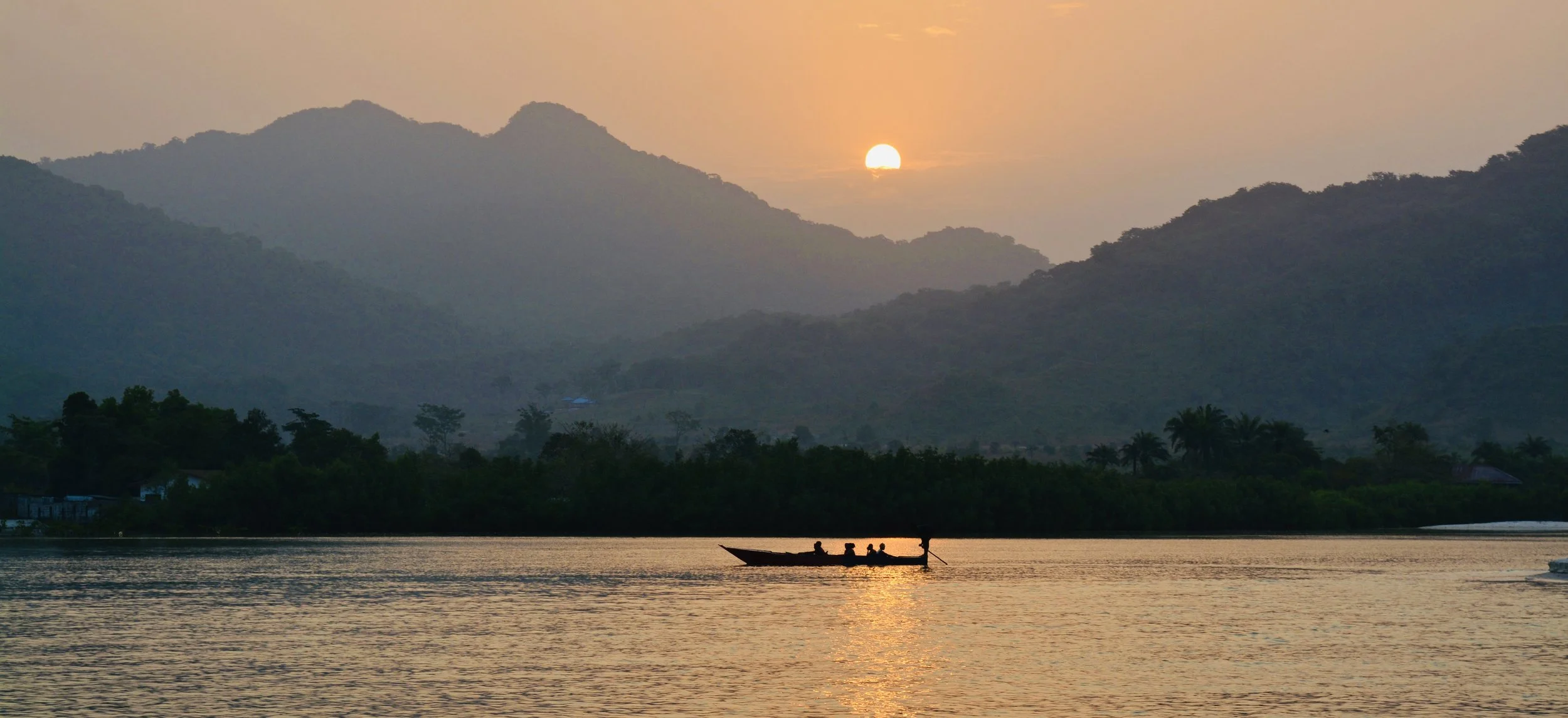
Considered one of the most beautiful beaches in Africa, River Number Two Beach is known for its white sand, emerald waters, and estuarial landscape backed by palm trees and mountains where river meets sea. Fresh seafood, cold beers and music on the weekend made for a lively scene. For those old enough to remember it, the iconic Bounty advert was filmed here - the taste of paradise. We spent the day doing what you’re supposed to do at a beach like this, lounging by the sea, smoking shisha, and swapping stories of our lives in Kampala and London. Lucy’s phone, meanwhile, looked like it had survived a small explosion. The screen was shattered, a side button had fallen off, and the back panel that was taped on sort of jiggled when she typed. “You’ve been texting me on that?” I laughed. Somehow it still worked. We got talking about Gola. It came up in the way things always do when Lucy is involved: a place, a rumour, a dare. We read about Gola’s biodiversity through the only shard of her screen that still responded to touch. As one of West Africa’s last remaining tropical rainforests, Gola had applied for UNESCO World Heritage Status. The journey would be long. It would be worth it. And though we didn’t know it yet, it would also remove our last reliable line of communication.
There was nothing online to reserve, so we planned to leave at first light for Kenema, the nearest town to GRNP headquarters. In dry season it’s roughly five hours from Freetown, assuming your definition of “departure time” matches Sierra Leone’s. Bus rides are part of the adventure in Sierra Leone. These were government buses and reasonably comfortable if you weren’t one of the unlucky ones who had to sit on plastic jerry cans in the aisles. Government buses are reasonably comfortable, unless you’re one of the unlucky ones on plastic jerry cans in the aisle. Government Wharf was already alive: vendors selling everything from earphones to ginger nut biscuits, which we obviously bought. Arrive by 5:00am for an “8:00am” departure. People form strict queues, marking their place with whatever they’re willing to leave on the ground. We got there at 4:45am and pulled tickets 27 and 28 on a 50-seat bus. The ride was slow and overcrowded, and with national election campaigning starting the next day, we hit more checkpoints than usual. Lots of enthusiastic smiling and nodding towards police always helps despite the chaos. After a while you settle into the routine: smiles, nods, patience. Kenema by midday.
We hadn’t been able to reach the park beforehand. In Kenema we learned why: senior directors from the RSPB (Royal Society for the Protection of Birds, a British flagship NGO) were due in town and preparations were in full swing for their official visit. Staff looked genuinely surprised to see us. We were the only travellers there. Although our arrival fell close to the two-year anniversary of Sierra Leone being declared Ebola-free (March 2016), tourism was still low, the long shadow of the 2014–2015 outbreak. They sat us in an office and promised someone would come. And then, as so often in West Africa, we waited. It was immediately clear GRNP was serious: a functioning conservation operation that regularly hosts researchers. The park is managed through a partnership between the government Forestry Division, the Conservation Society of Sierra Leone, and the RSPB.
Through the window the front yard was lined with trucks and mechanics, the air full of phone calls and fast-moving footsteps. From here, a 150-strong team manages operations across 71,000 hectares. One by one, trucks rolled out and disappeared down red dirt tracks, and the office suddenly felt quiet. Benjamin Barca, the technical advisor responsible for research, walked in and opened with a warning: in wet season, the mud reaches your chest. We assumed he was managing expectations. And in dry season? “Knees,” he chuckled.
“They were as bad as they come: potholes deeper than I am tall, corrugated washboard stretches that blurred your vision, the sensation of bolts loosening kilometre by kilometre.”
Over the day, staff sketched out a workable itinerary and assembled a team. The repeated caveat — that we would only be offered what was technically feasible — only made it more exciting. Vehicles might not reach our intended route. Trails might not be passable. As we sat among tables of maps and half-empty coffee cups, each static click of the walkie talkie’s signalled further updates from rangers deep in the forest. We met Lumeh, our lead ranger and trail expert, who had cut many of these routes himself. He was confident but blunt, the trails hadn’t been cleared in a while. Tourism had collapsed during Ebola. There was only so much a small team could hack back with machetes. There are three access points into Gola. Two run through Lalehun and Belebu in Gola Central, known for panoramic mountain viewpoints. We chose the third: the Sileti substation in Gola South. It sits 75km from Kenema, an uncomfortably long way on a motorbike. We opted for a park vehicle and were glad we did. We left that afternoon.
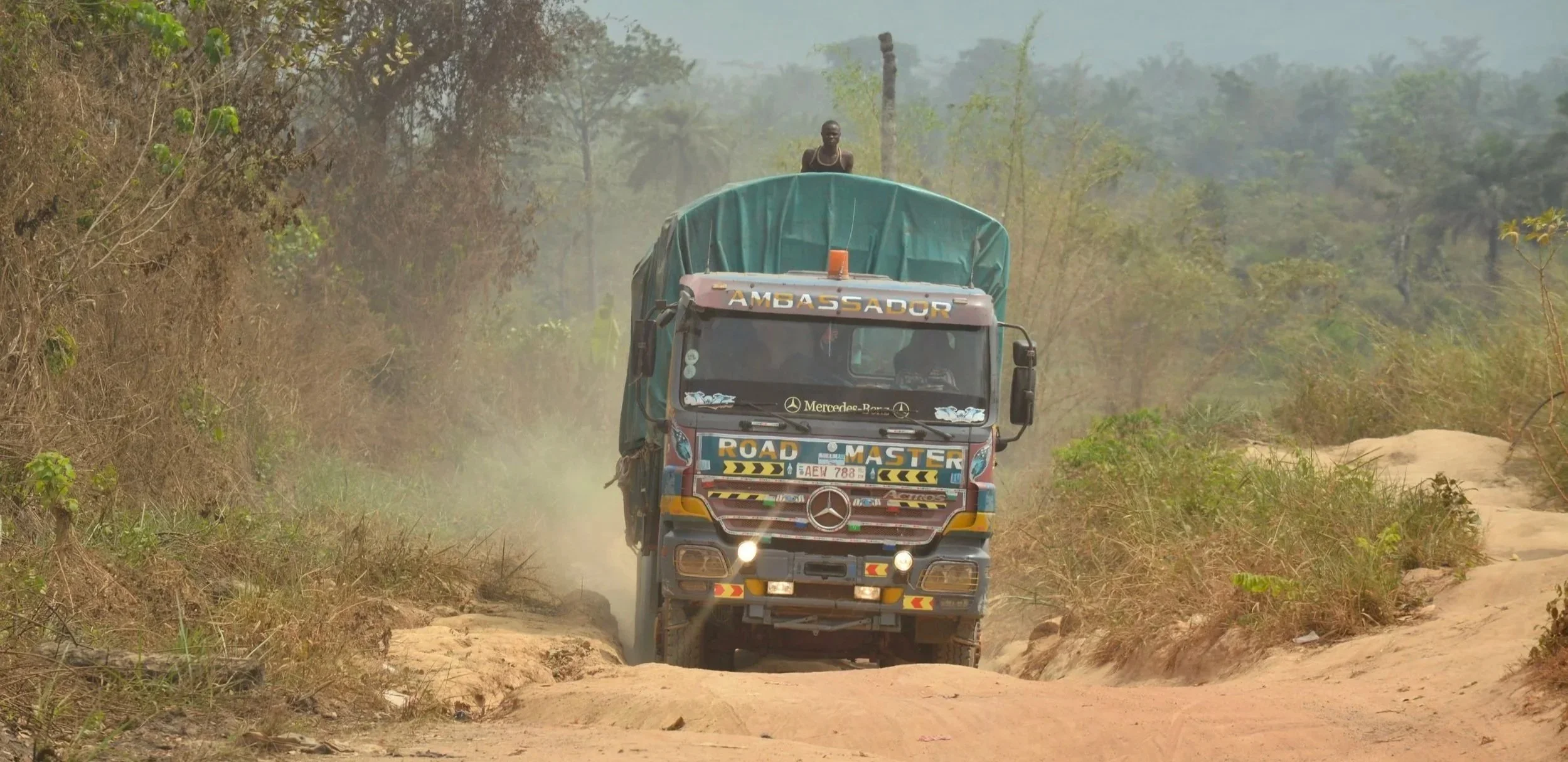
In the yard a huge white Land Cruiser waited with a pair of legs sticking out from beneath the bonnet. We loaded our bags in the cargo bed and by the time we reached the doors, the legs were gone. Mohammad was introduced as our supplies man, the person who would run camp during our expedition. His English was limited, but he understood meals and litres of water. With dusk coming and a long drive ahead, he chose not to stock up in Kenema. We would buy supplies in Sileti instead. After hearing enough about the state of Kenema road, we were desperate to get moving while there was still daylight. Then we met Sammy, our driver, and hit it off instantly. I sat up front and we traded stories laughing like we’d known each other forever. He was calm and unshakable on roads that seemed designed to dismantle vehicles. They were as bad as they come: potholes deeper than I am tall, corrugated washboard stretches that blurred your vision, the sensation of bolts loosening kilometre by kilometre. No wonder the park vehicles are serviced daily.
On one stretch we slowed to a crawl and an enormous Unimog-style expedition truck appeared ahead. “That must be Scott’s dad!” Lucy announced, already unbuckling. Scott, it turned out, was a loose end from Lucy’s overlanding orbit, a man she’d met in a nightclub in Guinea-Bissau, kept half in touch with, and somehow ended up discussing Gola with on day one. He’d promised that if he could reach Sileti in time, he’d join. His father climbed down in weathered boots and cargo shorts, his skin darkened under the African sun. The skin around his eyes and mouth was creased deeply as though squinting against glare and dust had become second nature. He said it was the worst road he’d driven in more than 1,000km of West Africa. He was also alone. Scott had made it to Sileti the day before and, true to his word, was waiting for us there. After exchanging polite pleasantries, we said goodbye and squeezed our truck alongside the enormous expedition camper the size of a tiny house and watched it disappear into red dust behind us. I couldn’t imagine how long he would be driving down the Kenema road.
It took another three hours to reach Sileti. By then the conversation had drifted, inevitably, to Ebola. The first confirmed Ebola case in Sierra Leone was a young woman admitted to hospital in Kailahun in May 2014. Her infection was traced back to a widely respected traditional healer. Patients had travelled to her in desperation. She became infected and died. In Kailahun, the Kissi burial tradition includes washing and dressing the dead, with mourners hugging and kissing the body. Hundreds attended the healer’s funeral. Health authorities later linked participation in that ceremony to a devastating chain of transmission, local accounts suggest up to 365 deaths. By mid-June the outbreak was clearly explosive and the government health system collapsed. Sierra Leone would suffer the highest number of infections and deaths in the West African epidemic. Thousands died. Doctors and nurses were among them, compounding fear and mistrust as facilities closed. The indirect effects of containment measures also led to massive economic decline and the resulting fear behaviour caused widespread social breakdown.
Sammy told us he had lost his entire family to Ebola. Like many Krio people we met, he didn’t dramatise it. He stated it, then kept driving, display a remarkable resolve to get on with getting on. That stoicism gave the trip a depth I hadn’t expected. Sammy carried the soul of our journey to Gola. We’d meet him again a week later, by chance, when we were stranded in an outpost village trying to find onward travel out of Sierra Leone. We were close to giving up when he rolled past in a motorcade escorting those same senior directors. “Need a ride?” he grinned, ushering us in and saving us hours at the notoriously slow and bureaucratic Liberian border. Thank you, Sammy, if you ever read this. You’re a real one.
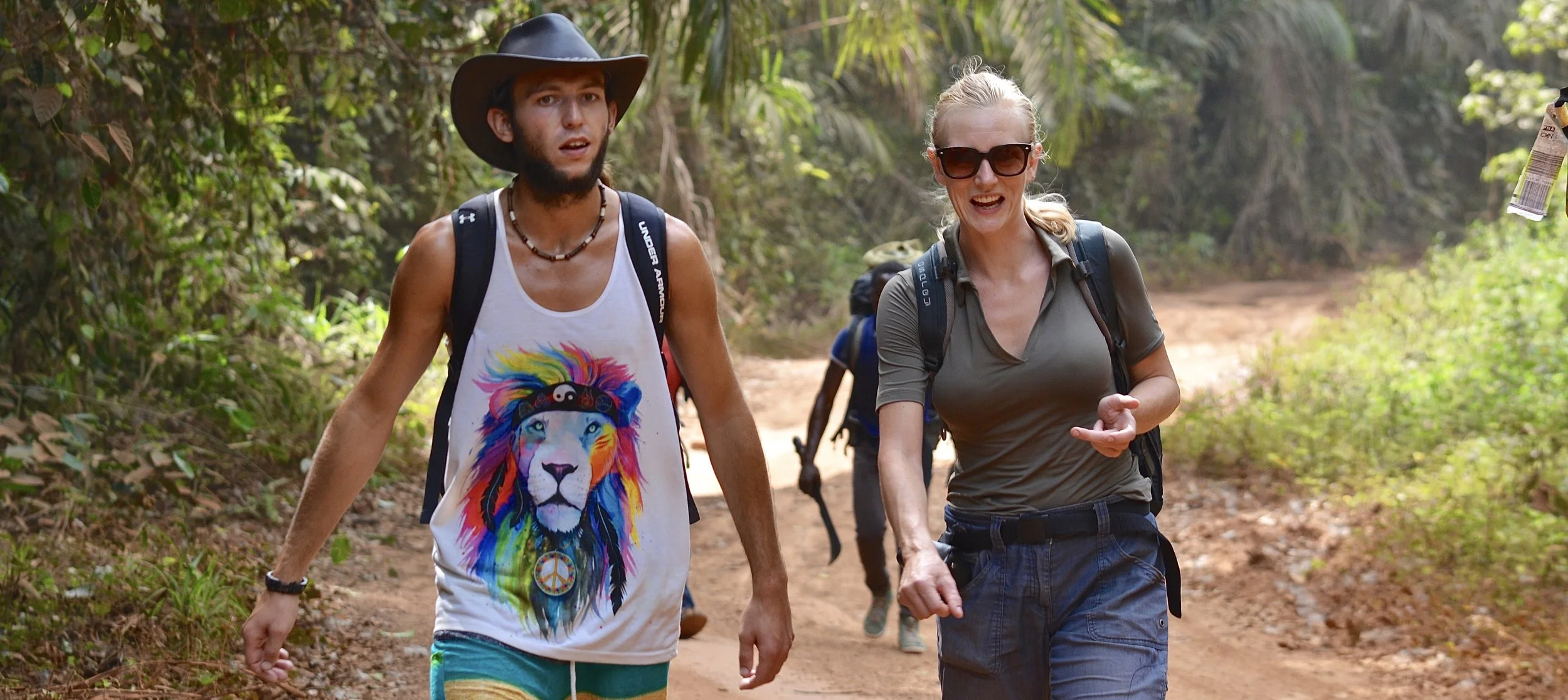
We reached Sileti about an hour before dusk and squeezed in a quick trail run before dinner, as if our legs hadn’t already been punished enough. That’s where we finally met Scott. Scott was light in the way of someone who lived out of a pack, all sharp lines, long hair, long limbs. He had an earnestness about him: open, curious, perhaps slightly naive, as though he’d traded comfort for stories and learned to wear both easily. I liked him immediately. I would’ve happily listened to his overlanding stories all night, but the day’s moving parts, heat, noise, waiting, had blurred into one dull ache. Exhaustion settled heavier than hunger. We ate briskly, exchanged excitement for Gola, and went to bed.
“Niangon’s grow in wet tropical biome and some are hundreds of years old. Their roots push above ground into wide, arched buttresses that spread metres across the forest floor. Several were so large they held trunk hollows big enough to shelter life, a fact we’d soon learn the loud way.”
The first day of Gola began with bony fish and bread. It wasn’t great, but at 05:00 in a village this small, it was what Mohammad could find. Given the pocket-size of his bags, we weren’t convinced the supplies were going to stretch. It was too late to share our frustration as we were now on a tight timeline and on the remote edge of the rainforest. “We’ll pick up more on the way,” we were told. I was already hungry despite having just had breakfast, and there was a full day of humid rainforest ahead. I was glad I’d stuffed my pockets with mint Cliff bars back in London, and of course we still had the ginger nut biscuits from Freetown. If I couldn’t be full, I could at least be sugared. After a final flask of the grittiest coffee, we packed up the Land Cruiser for a final time and continued into the rainforest. The foliage closed in immediately. The trail narrowed until branches scraped the windows like a relentless flora car wash. Visibility collapsed to almost nothing and within a kilometre the Land Cruiser began to lose the argument with the forest. Eventually, it stopped. From there, we walked.
Across three days and two nights our goal was to reach Tiwai Island, one of a cluster of river islands on the Moa. The rivers of Gola largely comprise the tributaries of the Moro-Mano, Mahon and Moa River basins. The endangered and very elusive pygmy hippo lives in this region (or “bog sausage” as I like to call them) though we didn’t see one. If you’re determined to try, the shorter trails from Sileti focusing on the Mahoi River offer better odds.
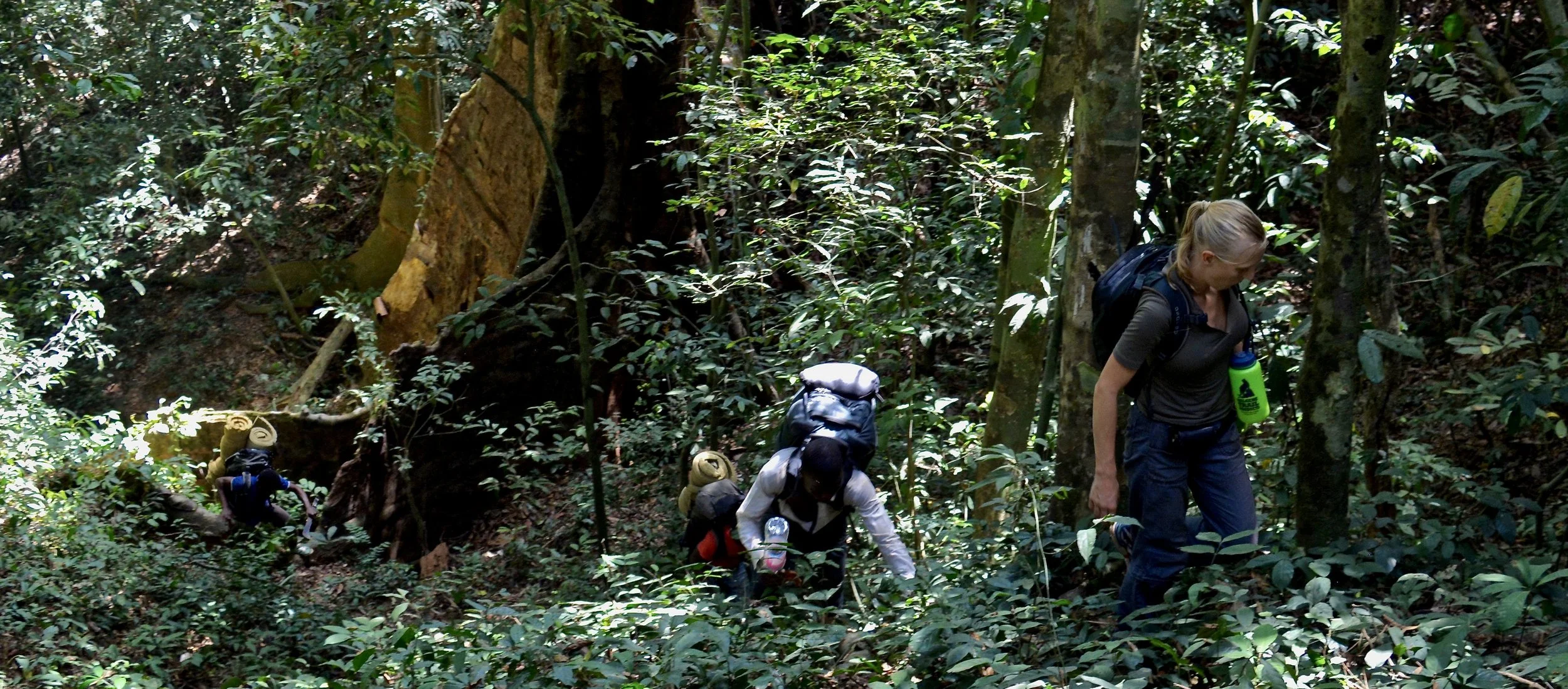
Gola is Sierra Leone’s largest intact remnant of the once-vast Upper Guinean forest. Of the 899 plant species recorded here, 232 are trees. Straight-trunked brachystegia with their paper-like dropping leaves rose through the lower canopy and endangered Baku trees climbed higher still. The tallest tree ever found in West Africa, the Big Tree of Oda in Ghana, belongs to this species. Above them all, the niangon (heritiera utilis) dominated, its immense crowns projected overhead, sheltering us from the midday sun. Niangon’s grow in wet tropical biome and some are hundreds of years old. Their roots push above ground into wide, arched buttresses that spread metres across the forest floor. Several were so large they held trunk hollows big enough to shelter life, a fact we’d soon learn the loud way.
“Balancing a 100-litre duffel on your head while inching along a mossy, rotting log barely breaching silty water is exactly as hard as it sounds. In mosquito-dense heat, I couldn’t imagine the misery of falling in.”
We made slow, stubborn progress, ducking under trunks, scrambling over toppled trees and I began to regret the trail run from the evening before. Our thighs and lower backs were not impressed. Mohammad and Lumeh moved like the forest had raised them, balancing on slick logs while carrying the weight of camp. Lucy, Scott and I flailed behind, trying to look competent.
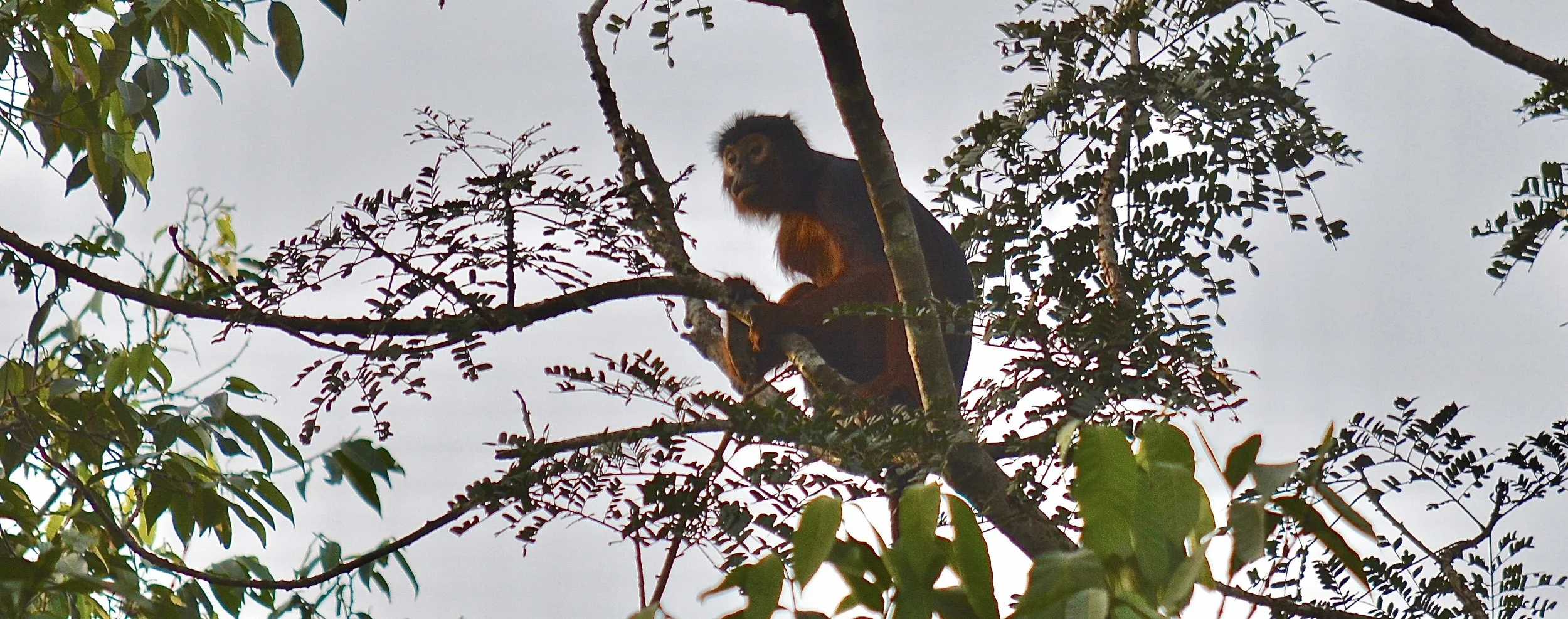
Our conversations kept breaking off at the sound of movement overhead. We’d stop, listen, and watch colobus monkeys swing through the canopy above us - Western Red Colobus, then King Colobus, appearing and vanishing. ‘Colobus’ comes from the Greek for ‘mutilated’, referring to short stump where the thumb would be. As a consequence of its diverse vegetative uniqueness, the forest accommodates approximately 49 species of mammals of which nine are considered to be threatened. The King Colobus is endangered, its numbers hammered by habitat loss and hunting for bushmeat (an estimated decline of over 50% in 30 years). It was therefore a treat to see them.
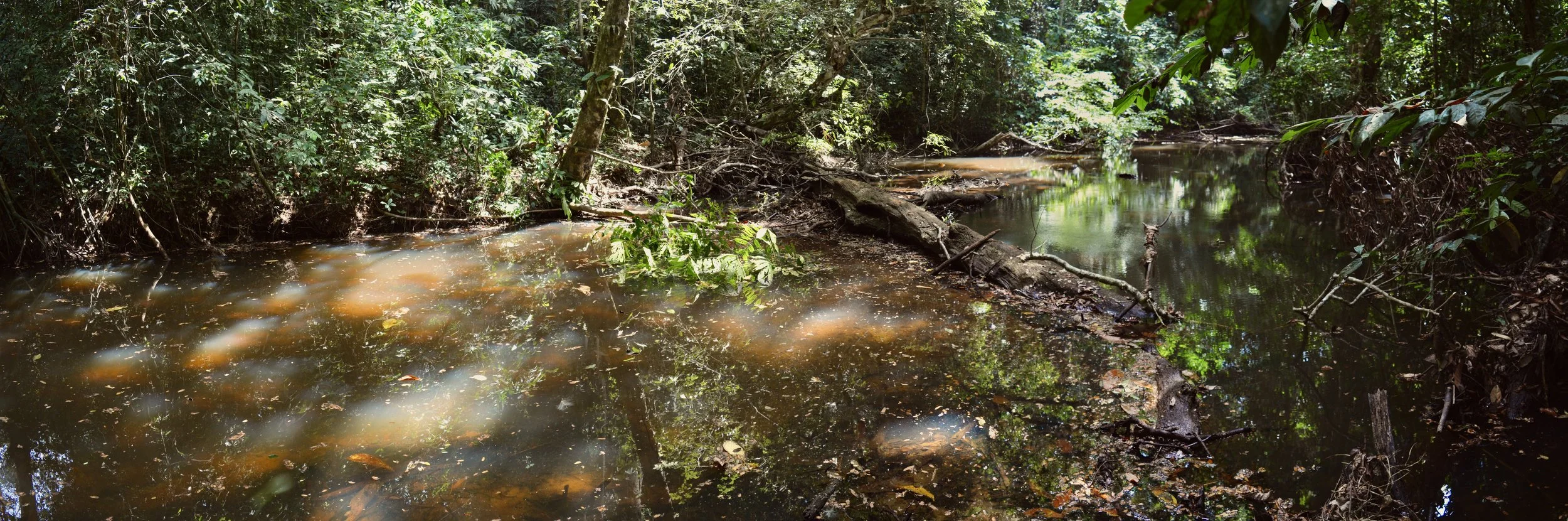
Gola South is particularly characterised by dense underbrush and swampy river valleys. By mid-afternoon, Lumeh, our trail expert, must have been hacking at foliage continuously for a couple of hours now. A stretch of deadwood and decomposing leaves opened out in front of us. We were close to water. River crossings ranged from easy to genuinely tedious. Fallen trunks were usually the only bridge, unless we wanted to wade. Balancing a 100-litre duffel on your head while inching along a mossy, rotting log barely breaching silty water is exactly as hard as it sounds. In mosquito-dense heat, I couldn’t imagine the misery of falling in.
After one crossing we hit a steep embankment slick with wet shrubbery. Dragonflies spiralled in bursts. Butterflies blundered into our faces. Then a harsh, sudden cackle exploded from the undergrowth and nearly sent me back down the slope. A beat later came an even louder: “bloody hell!” Scott was tumbling amid a frantic burst of grey plumage, a guinea fowl detonating into flight directly in front of him. I grabbed a brachystegia trunk and smeared my hands in its reddish sap. Scott had no anchor. For a second I was sure he was going in.
There are few flight paths available to a startled guinea fowl in the density of Gola. He’d disturbed a mother nesting in a niangon hollow, brooding her eggs. She got away. Scott ended up on his arse, but not in the river. Once we stopped laughing, the obvious thought arrived: the eggs. My mouth watered at the idea of anything that wasn’t Mohammad’s set menu of fish and bread. We wrapped them carefully in one of Lucy’s spare headscarves. I joked that the forest would provide what Mohammad could not. The boys liked that. We teased him with it for the rest of the day
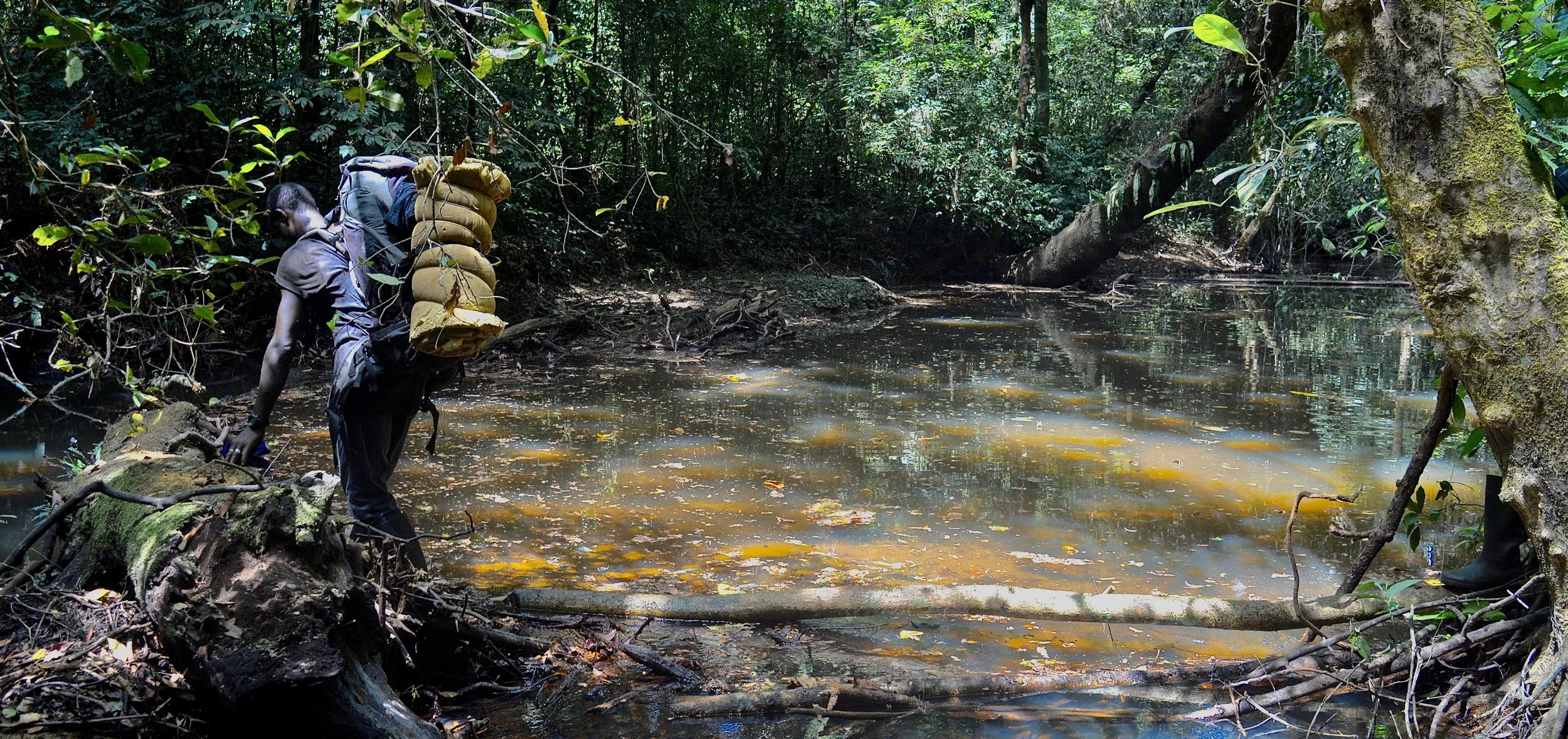
As dusk fell we scouted for camp and chose the banks of the tiny Fayea River, roughly 13km from Sileti. Calling it dry ground would’ve been generous, it was a swamp. Mohammad and the boys built a fire and a rough bench from vine and branch. Lucy and I handled tents. Scott floated wherever he was needed. Looking at our rudimentary camp, it struck me how quickly the park had made this possible for us with barely an afternoon’s notice. It was very cool. After booting in the final peg, I don’t think I had been more drenched in sweat, ever. With dinner in the pot, Scott and I went looking for somewhere to wash. This section of the river was two metres wide and shallow so we went in search of a better spot downstream.
“A few sips in, my heart rate went strange, my skin felt sunburnt from the inside, and we were laughing with no clear reason.”
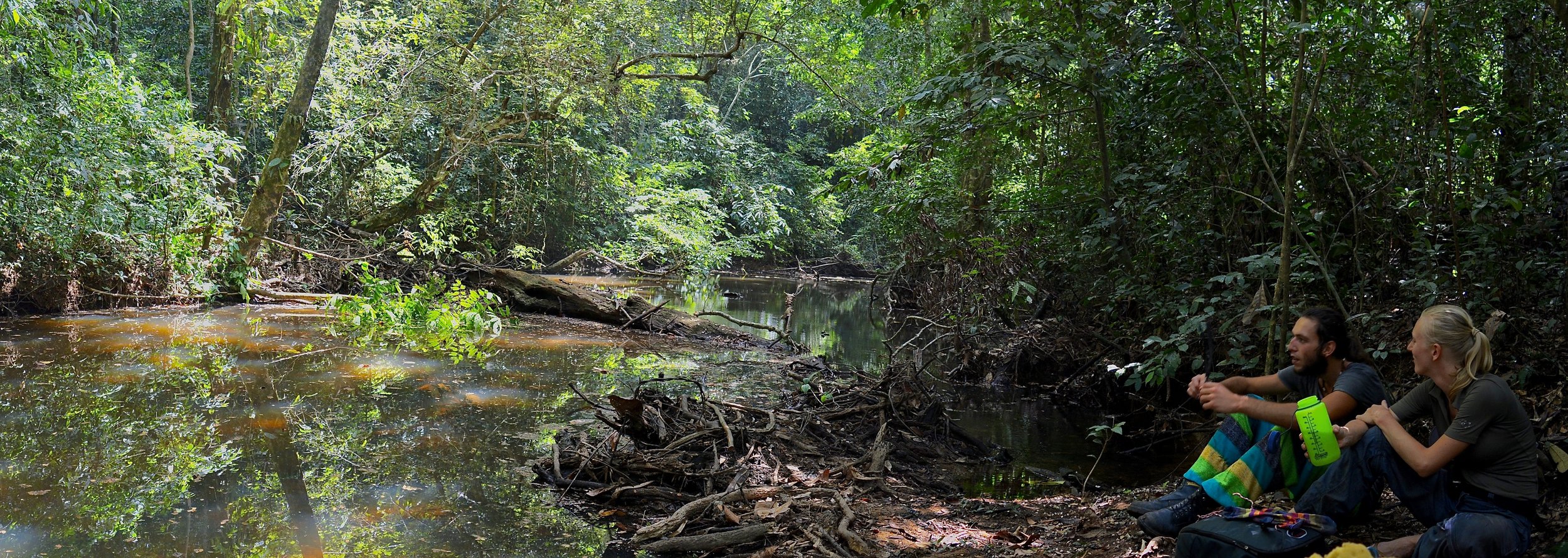
The earth was damp and the air heavy. Each step was cushioned by thick moss matted and clinging to every living thing from root to branch. While Gola’s rivers are not commonly referred to as blackwater rivers, their waters share characteristics with blackwater systems due to their high acidity and low mineral content. They appear dark stained or ‘tea-coloured’ which results from decaying leaves and roots and the dense forest canopy that allows very little light to penetrate the water. A faster bend appeared downstream, enough current to dunk our heads. We stripped off filthy layers and plunged in. Lumeh had followed and sat on the bank with his machete, expressionless, watching our ecstatic splashing. I’m not sure if he was guarding us or just curious. Either way, we didn’t care. It was glorious.
We paused, dripping, and noticed the frogs. At the time I didn’t know what they were. Later, back home, the photos led me to sabre-toothed frogs. They are fanged, predatory and known to much on other frogs. In 2014, it was discovered that they belong to an entirely new family of frogs, likely split from other lineages since the Cretaceous. Very cool. This 100 million year old family are the only endemic vertebrate occurring in the Upper Guinea forests. The kind of fact that makes a place feel even more irreplaceable.
Downtime by the river was glorious. The humidity eased, I had changed into clean clothes and smoke from the fire kept mosquitoes at bay. The waterlogged swamp forest was the perfect place to hang the hammock. I had forgotten to pack hammock straps so I improvised with backpack straps and Lucy’s belt buckle, not elegant but it worked, sort of fine. I snapped a quick selfie with Mohammad and read my book: gurgling river to my left, bubbling tea to my right. Mohammad brewed a local bark tea known in Mende as neinemagboi. Mende is spoken by the Mende people and other ethnic groups in southeastern Sierra Leone. The more common name for the tea was ‘ataya’ although this was not at all the Senegalese style I had been acquainted with before. It is bitter, despite all the sugar, and marketed, like most miracle teas, as protection against malaria and ulcers. He warned it would make us hot and sweaty for hours. Exactly what we needed after 13km of forest trekking and having just gotten clean. A few sips in, my heart rate went strange, my skin felt sunburnt from the inside, and we were laughing with no clear reason. I looked at the group wide-eyed and smiled, “magic,” before we dissolved again unable to discern what was so funny.
Supper consisted of fish and rice with krain leaf sauce, green cream in local cooking, which is made with krain-krain leaves and a lot of palm oil. Our stomachs took a few days to acclimatise to how generously palm oil is used in Selon cuisine. We also ate the guinea fowl eggs of course, rainforest to table. They were delicious. Just don’t arrive with a delicate digestive system. With our bellies full, we settled in for more tea around the fire while doing impressions of Scott’s yelp until only embers lit the space between us. I took myself off to bed and promptly tripped on a vine two metres from my tent. After a day of navigating endless obstacles, this was when I ate dirt. Unbelievable.
“Something wasn’t right. I unzipped the vent further, grabbed my headlamp and lit the ground outside. It was at that very moment I saw them.”
I awoke in the dead of night. Cicadas buzzed as usual, but beneath them was something else: a scuffing and fumbling that didn’t belong among the usual sounds of nocturnal activity. I rolled over and saw it was 2:00am. The air was hot and the relentless humidity had dehydrated me. In darkness I could only feel the moisture dripping from the inside of my tent. I was drawn back to the unusual sound of movement now with an energy that implied urgency.
I got up and unzipped one of the vents half way and poked my head out. Shapes came into focus around me as my eyes slowly adjusted to the soft moonlight. “Lucy?” No response. Something wasn’t right. I unzipped the vent further, grabbed my headlamp and lit the ground outside. It was at that very moment I saw them. An army of African weaver ants, kowei in Mende, marched through camp like something out of The Poisonwood Bible. Only the tips of my sandal straps were visible above a moving mass of orange-brown bodies. I had never seen a colony this large. Weaver ants are arboreal and live in heavily forested areas. They are relatively large and aggressive and they do not hesitate to attack. If a bigger animal disturbs them, thousands of ants will drop down from their tree nests to attack the intruder, biting it with their mandibles and spraying formic acid at the bite wound. We didn’t know this at the time and I’m glad of it.
A battalion had broken away and found a small hole in Lucy’s tent. In total darkness, she rummaged for her headlamp lost somewhere inside kit that was now crawling. This was the scuffing sound that had woken me. Lucy couldn’t see them yet, but she could feel them. These were the sort of ants that you can pull from your skin but only the body detaches leaving the mandibles behind. Now fully alert, I could see that Lucy’s tent was totally surrounded and there was no way I could help her. In the chaos Lucy found the ginger nut biscuits from the bus park. Willing to try anything, she threw one into the abyss like a decoy. It did not work. Who knew ginger nuts offer no meaningful ant crowd control whatsoever? Lucy sealed the vents tight, including the mesh door, cutting off ventilation completely while efforts returned to clearing her tent and body of the invaders. After that day’s humidity the last thing we needed was less sleep, but the condensation build-up made the rest of the night a sticky ordeal. Lucy has always had more mettle than I do. If that had been my tent, they’d have heard me back in Freetown.
“If you didn’t hear from us in Sierra Leone, weaver ants were the reason why.”
Surprisingly, not another soul woke during all of this. The camp didn’t stir until shortly before sunrise as the dawn chorus of birds began. I unzipped my tent to see Mohammad illuminated by sunbeams filtering through the canopy as he prepared our fish and the last of the eggs with a big pot of coffee swinging over a new fire. He nodded at me but I felt strangely locked inside my body as though my limbs were refusing to move. A Gola malimbe bird stood in the tree above me. They clatter and wheeze and I considered for a moment that he might be laughing at my attempt to cross this rainforest. Lucy was next to emerge. The wet folds of her tent door slowly zipped aside and our eyes met in silence. I couldn’t imagine the night she’d had.
Dragging myself in the direction of the hot steam from the coffee pot, like that scene in Tom and Jerry where Tom floats towards the pie on the window ledge, I prepared and brought a cup of coffee filled to the brim over to her. As she took that first sip, I matter of factly stated that I didn’t think Gola ants had a taste for ginger nuts. We both burst into laughter as we heard Mohammad calling us to breakfast. There was another day to go and we had better get on with it. In the light morning we soon discovered the condensation had also killed Lucy’s phone for good. The already-shattered screen finally gave up. If you didn’t hear from us in Sierra Leone, weaver ants were the reason why.
The final slog toward Tiwai was brutal. We lost the canopy and stepped into tall, sharp grasslands in midday sun, sleeves pulled down against blades that cut. Smoke from fire-fallow cultivation, still relatively common among Gola communities, turned the air grey and abrasive. I felt lightheaded, weak, and quietly furious at my own body. These sections were once rainforest. Logging from the 1930s to the 1980s, then civil war (1991–2002), tore into Gola and its wildlife. The recovery effort since has been enormous, including the Gola REDD+ Project, which helps prevent deforestation and funds eco-guards while supporting sustainable alternatives such as cocoa farming.
“Gola remains a sanctuary for rare species hanging on in one of the last fragments of Upper Guinean forest, and an emblem of the work being done to protect what’s left.”
By late afternoon we reached a small village. Children gathered instantly - football, photos, the usual joyful chaos. They could’ve walked off with my Nikon and I’m not sure I would’ve had the energy to care. I found the physical exertion to be immense. Looking back, I don’t think I could’ve managed another full day without rest. Soon we were called to meet the village chief to request permission to camp by the next river. The process was customary and painless, though I’m sure some form of payment changed hands between Mohammad and Lumeh. With permission secured we were escorted through a pineapple plantation to our camp. It was excellent, the canopy thinning into a shady lagoon that opened into the river. A clear blue evening sky shone above glass-still reflections disturbed only by a trickle from a rocky stream beside us.
The dusty Harmattan winds roll in from the Sahara between November and March, and the clear evening felt like a gift. A lazy night by the water was a welcome distraction from the fatigue of overlanding. We dared each other to swim out to distant rocks and made it halfway before losing faith and hurriedly returning. Slender-nosed and African dwarf crocodiles live in this river. Some had been confiscated from the exotic pet trade and released by the Gola research team. Despite their name, they’re not that small the word and I did not fancy my chances. We relaxed beside the river’s edge watching shining-blue kingfishers dart into the river while the boys were busy preparing our supper. Though it was made from palm leaves like before, we later voted it the best meal we ate across five weeks of overlanding. Feeling inspired and excited about our impending crossing to Tiwai Island, we each enjoyed our meal including a surprise treat of plantain and fresh pineapple courtesy of the chief.
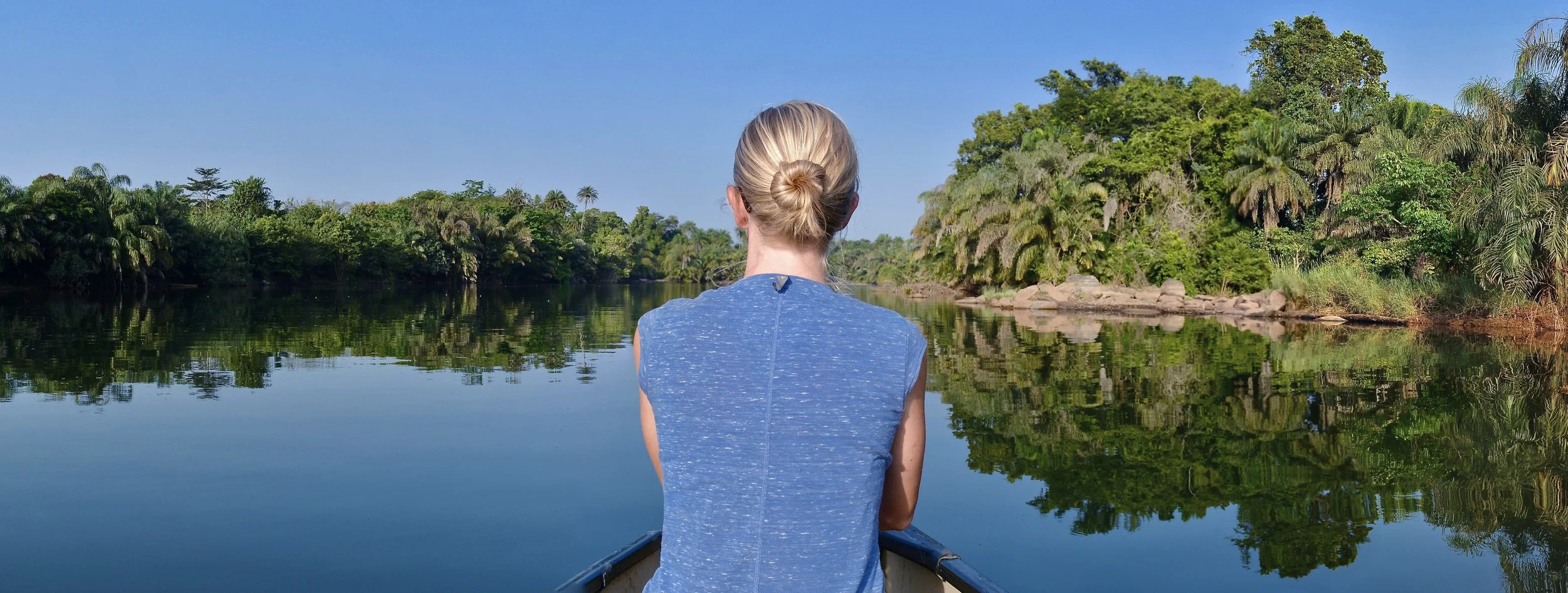
As the mist lifted from the river at dawn, we packed up and moved on. The rainforest had tested us with its demanding paths and unpredictable moments but its raw landscape rewards those who venture in with a connection to the earth. Gola remains a sanctuary for rare species hanging on in one of the last fragments of Upper Guinean forest, and an emblem of the work being done to protect what’s left. It is also a reminder of what the world could look like if we protected more of our wild spaces. We boarded a small canoe and pushed away to begin our crossing to Tiwai Island as the rainforest’s rhythm, ever so quietly, continued on behind us.
Field Notes | Conservation | GRNP
Gola Rainforest National Park: Now a UNESCO World Heritage Site and a Model for Conservation
Nestled within the Greater Gola Landscape, a 350,000-hectare expanse of tropical forest straddling the border between Sierra Leone and Liberia, the Gola Rainforest National Park (GRNP) has officially been recognised as a UNESCO World Heritage Site. This prestigious designation cements the park’s status as a global treasure, renowned for its exceptional biodiversity and vital role in preserving one of West Africa’s last remaining tropical rainforests.
A Biodiversity Hotspot
The Gola Rainforest is a haven for endangered species and a critical refuge for biodiversity. Home to more than 60 globally threatened species, the park provides shelter to rare and iconic animals like the Western chimpanzee, pygmy hippopotamus, and African forest elephant. The region is also notable for its extraordinary flora, with roughly half of the park’s 900 plant species endemic to the Upper Guinean Forest ecosystem—an area once vast but now severely diminished by deforestation.
The park’s rich biodiversity is further bolstered by its designation as a "glacial refugium," meaning it harbors species that have survived since the ice ages. This unique role in the survival of both flora and fauna has made Gola a critical site for global conservation efforts.
Overcoming Conservation Challenges
While the recognition as a UNESCO World Heritage Site is a significant milestone, Gola faces ongoing challenges. Habitat loss, driven largely by agricultural expansion, has already claimed nearly a third of the forest over the past 40 years. Agricultural pressures from nearby communities, who rely on the forest for resources, remain one of the most pressing threats to the park’s future.
To combat these challenges, the GRNP is protected year-round by 50 guard patrols, significantly reducing poaching and illegal activities. The park’s management also emphasises community engagement, working with the seven chiefdoms in the region to promote sustainable land-use practices and reduce deforestation. These efforts are vital in balancing conservation goals with the needs of local populations, some of the poorest in Sierra Leone, who depend on the forest for their livelihoods.
A Transboundary Vision for the Future
Though the GRNP’s UNESCO recognition currently applies to areas in Sierra Leone, there are plans to extend protection to the Liberian side of the border, creating a transboundary World Heritage Site. This expansion aligns with recommendations from the International Union for Conservation of Nature (IUCN) and reflects a growing commitment to cross-border conservation efforts. The Gola National Forest in Liberia, which lacks protected status, faces significant threats from unregulated logging, mining, and hunting, making the establishment of a transboundary site all the more crucial.
Carbon Sequestration and Sustainable Development
In addition to its ecological significance, the Gola Rainforest also plays a key role in climate change mitigation. The park locks away an estimated 19 million tonnes of carbon, making it a critical asset in the fight against global warming. To ensure its long-term protection, Sierra Leone has launched its first carbon REDD+ project in the area, which seeks to secure funding for conservation while benefiting local communities through sustainable land-use practices.
The park also supports sustainable agriculture initiatives, particularly with cocoa farmers in the region. The GRNP partnership helps farmers improve the quality of their cocoa while promoting zero-deforestation practices. This initiative is crucial in reducing the negative impact of fire-fallow cultivation on the forest. A highlight of this partnership was the successful launch of Gola Rainforest chocolate in 2017, which even made its way to San Francisco for sale. Today, you can purchase this unique chocolate through the RSPB online shop, helping to support both local farmers and conservation efforts.
A Bright Future for Gola Rainforest
The recognition of Gola Rainforest National Park as a UNESCO World Heritage Site marks a major achievement in global conservation. This designation not only acknowledges the park’s outstanding universal value but also highlights its importance as a model of conservation that integrates biodiversity protection, community engagement, and sustainable development.
As efforts to expand the park’s protection into Liberia continue, Gola’s future looks even more promising. The combination of international recognition, local engagement, and sustainable practices offers a hopeful path forward for this irreplaceable rainforest, ensuring that it will continue to thrive for generations to come.