Liberia: Part Two | The Road to Nimba
On our final morning in Robertsport, I realised I’d misjudged my cash. There was no functioning ATM in town. The surfer vibes were distinctly African but they came at American prices. Liberia imports almost everything, and prices reflect it. Fuel, food and transport arrive layered with port fees and poor roads. Add the US dollar, widely used alongside the Liberian dollar, and the presence of NGOs and aid workers who can absorb higher costs, and prices begin to resemble those back home.
“Seconds later he was shouting, his gestures sharp and accusatory. When I finally produced my passport and stepped out, an official explained the problem.”
The next day it was time to leave Robertsport for the capital, Monrovia. In the morning, I headed out early to find an ATM. I wandered past the only petrol station in town and decided to buy some snacks for the three hour drive to Monrovia. The ladies in there were lovely. They had peanut brittle which is a favourite of mine on long journeys. I explained we needed transport to the capital and it turned out they were friends with one of the pump attendants. Most private taxis go for around $80 but he was willing to take us for $40. This was an unheard of price which we accepted immediately. I’ve read prices online as high as $150. We set off less than an hour later.
Checkpoints in Liberia have long been a part of the national security narrative. The country has a long and tragic history characterised by civil wars, political instability, and rampant corruption. As citizens grappled with violence and terror, the government established checkpoints ostensibly aimed at quelling these threats.
Somewhere along the Trans–West African Coastal Highway, on the drive to Monrovia, we were waved into a roadside checkpoint beside a loose cluster of concrete civic buildings. Lucy and the driver headed up steps toward a steel-doored office for passport inspection while I dug through my bag, having misplaced mine again. As I leaned out of the open car window, arm buried to the bottom, I caught sight a man raising the Liberian flag in the centre of the clearing.
Seconds later he was shouting, his gestures sharp and accusatory. When I finally produced my passport and stepped out, an official explained the problem. It was customary to stand for the raising of the flag, and I was accused of laughing during the ceremony. Lucy insists I must have laughed, I’m certain I didn’t. What followed felt familiar enough. The story grew sharper and the offence more serious until a request for “compensation” surfaced. I declined. When our passports were returned and we walked back to the car, the man had already disappeared.
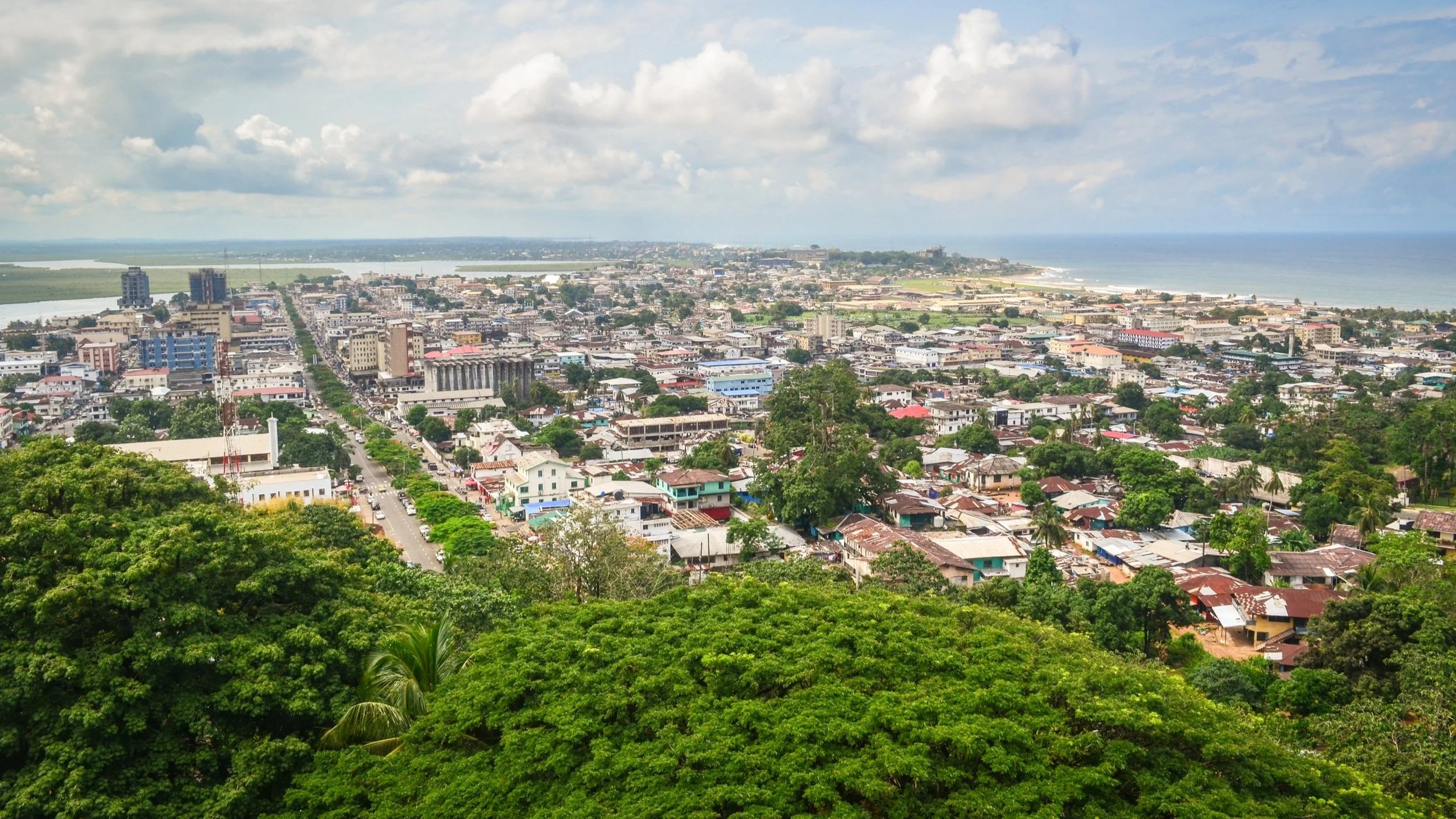
We reached Monrovia later that afternoon. Traffic snarled around market stalls, generators rattled behind concrete walls, and the Atlantic pressed close along the coastal road. American echoes were everywhere. Men leaned against oversized pickup trucks in mirrored aviators with their baseball caps pulled low, and billboards and churches borrowed the cadence and confidence of the southern United States. The city felt outward-facing and improvised, its energy sharper and louder than anything we’d felt in Robertsport.
We stopped for lunch and the bill landed with a thud. Our meal, fried and unremarkable, cost more than two entire days back in Sierra Leone. It was the same story everywhere we checked. By the time the plates were cleared, the decision had made itself. We wouldn’t linger. Mount Nimba would come next. We spent the rest of the afternoon moving through heat and traffic, watching the city operate at full volume, knowing already that we were only passing through.
“As passengers settled, a woman wedged plastic bags beneath the seats and negotiated space with a chicken tied by the legs.”
Early the next morning, we boarded our transport northeast. It was a van converted into a minibus and packed for the long haul to Nimba County. A young man lifted our bags from our hands and disappeared with them toward the rear. They were going on the roof, we hoped. Inside, the seats were salvaged from another vehicle and welded directly to the floor, five to a row and barely spaced. We claimed the third row, our knees pressed in. It was cramped, improvised and rudely functional but our only transport option for the next six hours.
As passengers settled, a woman wedged plastic bags beneath the seats and negotiated space with a chicken tied by the legs. At some point a baby was hurriedly placed in my arms. His wide-eyes met mine, curious, and silent. Moments later, his mother hooked him back under the arms and reclaimed him. I glanced down at the child and then up toward the roof, briefly wondering whether our bags had made it there after all. When the engine finally turned over and Monrovia began to slide away, I felt like the journey was about to do the shaping again.
As the van pushed inland, a young man leaned out of the sliding door, calling for passengers whenever we slowed through market towns and roadside trading posts. Beside me sat a boy of about five. From time to time I passed him pieces of peanut brittle, which he accepted without comment before returning to his quiet study of us as I scribbled my field notes with the help of my Nikon.
It was the photographs that held him. Whenever images flared across the screen, he leaned closer, drawn by the colour. We never spoke, but there was an understanding of sorts. When his stop came, he sprang up, grabbed his mother’s bags, and disappeared into the dust kicked up by the van’s abrupt halt. There was no goodbye. That, too, felt like part of the journey, the kind of brief, unremarked exchange that still survives in places where travel hasn’t yet been over-scripted.
A few hours into the drive, we were dropped at a remote trading station and told to get out. There was no explanation but the ritual felt familiar enough. I checked the roof first and spotted my yellow duffle was tied down, as hoped. We were switching vehicles, apparently. These routes do not run on a schedule and explanation rarely features.
Arms waved us toward a broken fence across the road where we stood with our bags and waited for something to happen. Nothing did. Ten minutes later our original van was now packed with new passengers and piled high with produce. As the doors slammed and the engine turned over, I realised my GoPro was still in the front cubby. I ran across the junction and leaned in through the driver’s window, shouting the only word that mattered. He looked blank, then turned to his passengers as if asking if anyone spoke English. With no other option, I climbed over him and retrieved it myself. I’ve left cameras on buses all over the world. Lucy watched from the roadside and smiled, a quiet acknowledgement that some habits survive every journey.
“The following morning we found a guide to take us toward the upper slopes of Mount Nimba. His name was Darpay Moses, though I privately referred to him as our “country plum” for his soft sweetness and good humour, a name he was pleased to accept.”
By late afternoon we had covered more than 330 kilometres in just over six hours, sandwiched into a van built with little regard for comfort. Gradually, the road began to change. It narrowed and climbed, the air cooling as forest pressed in from both sides. At Liberia’s northern edge, Nimba County feels set apart from the rest of the country. We reached Yekepa at the foot of the Mount Nimba range, where low buildings and old mining remnants sat back from the road. We climbed out stiffly. After a day of constant movement, the town felt subdued and its residents appeared briefly unsure what to make of us.
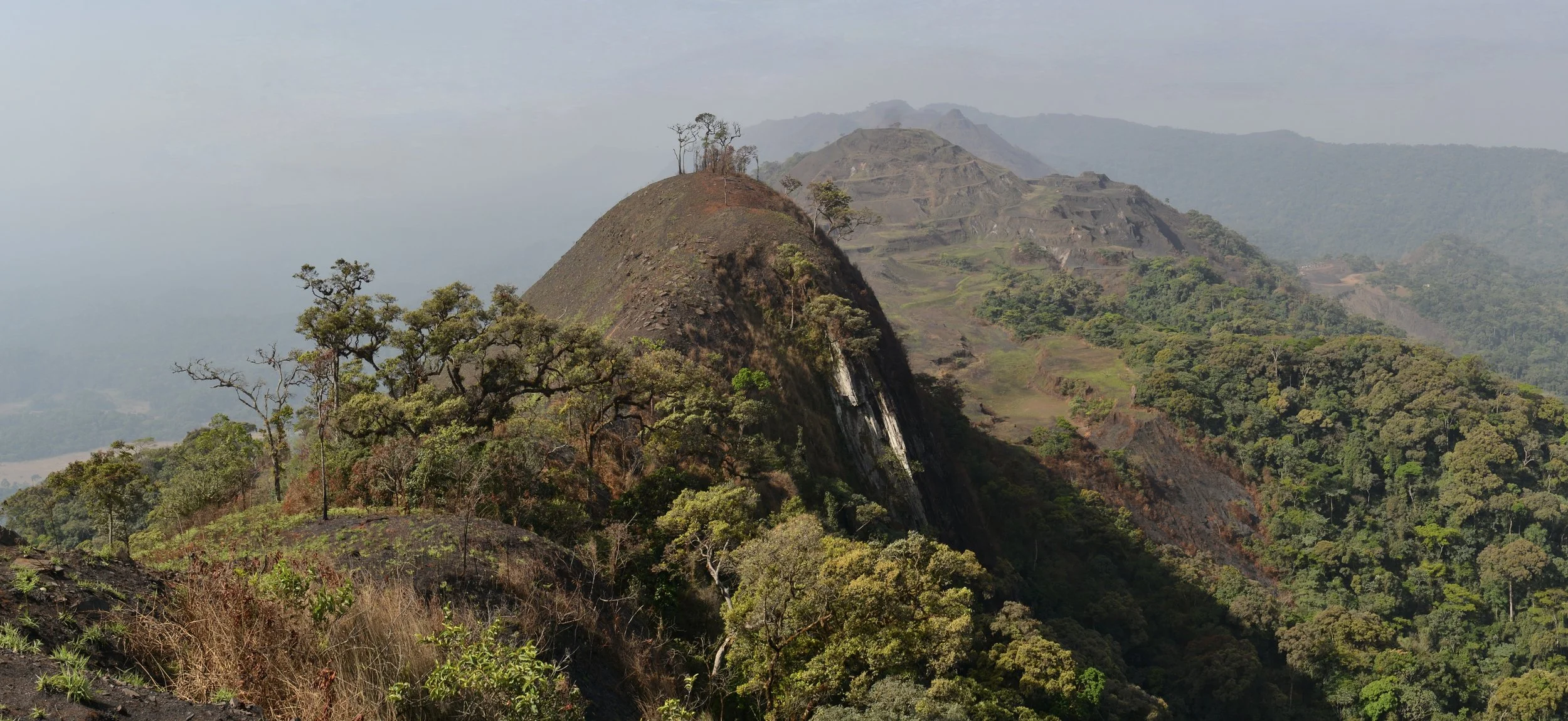
Yekepa sits right at the edge of the highlands, and you feel the shift almost immediately. Beyond town, the land tightens and rises into the protected slopes of the Nimba Nature Reserve, which safeguards Liberia’s share of the Mount Nimba massif, recognised as a UNESCO World Heritage Site just across the border in Guinea and Côte d’Ivoire. The forest thickens quickly, paths slipping uphill into dense green. The air was cooler here, damp and heavy. It didn’t possess mountain drama in the obvious sense. Instead it built quietly with steep slopes layered with rare plant forests and animals adapted to narrow bands of altitude, a place where weather shifted without warning.
In places, mining scars showed through. Despite this, human presence and abandoned infrastructure felt provisional against the hills. While exposed rock and broken ground were the obvious remnants of the iron-ore industry that once defined the town, we would soon see how the forest is steadily reclaiming it.
The following morning we found a guide to take us toward the upper slopes of Mount Nimba. His name was Darpay Moses, though I privately referred to him as our “country plum” for his soft sweetness and good humour, a name he was pleased to accept.
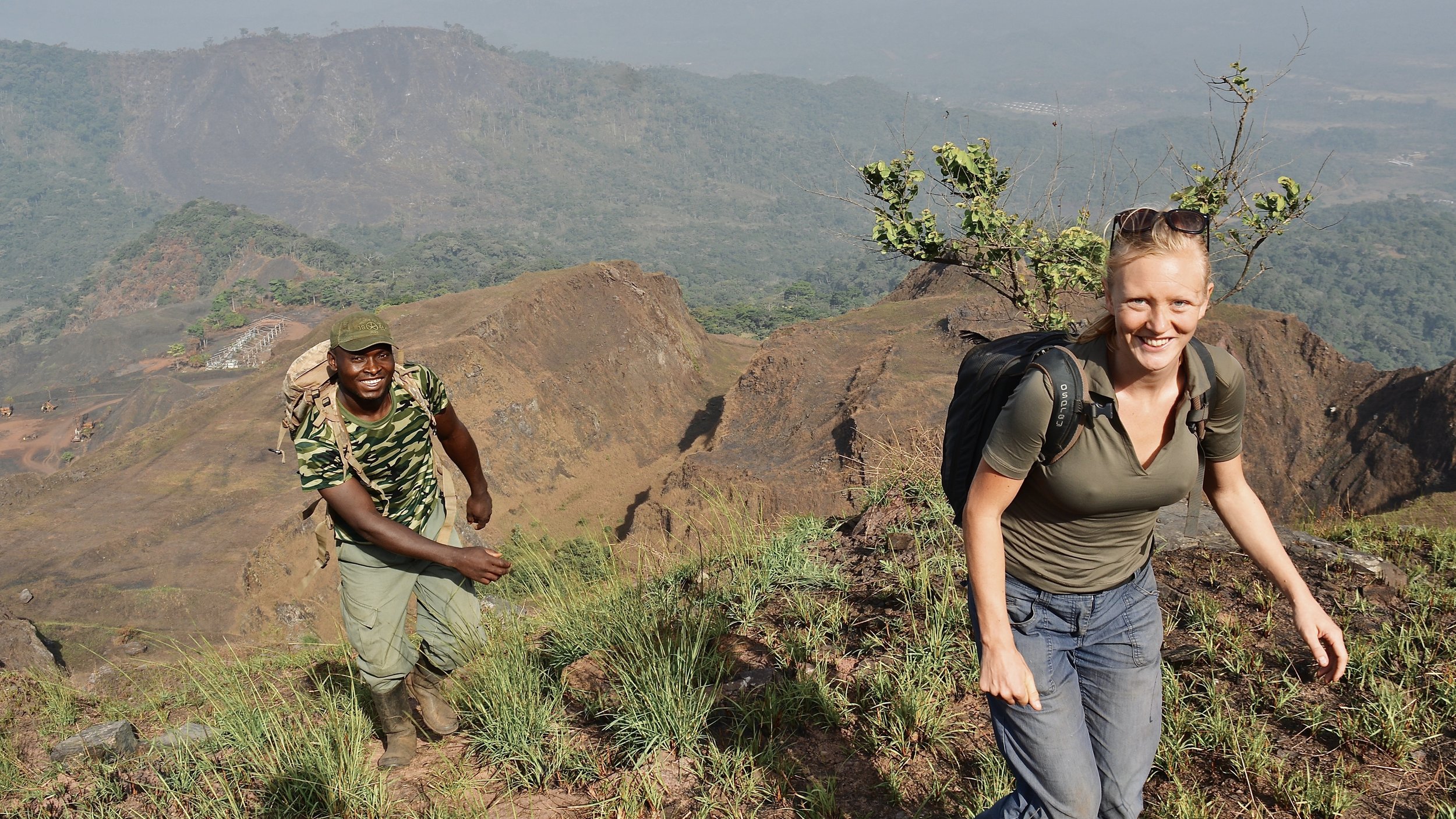
Mist hung low as we set off. The climb up Mount Nimba started on a narrow forest path and the ground was soft and dark, slick in places. Leaves brushed our calves. Insects hum without pause. Birds cut through the canopy but stayed mostly unseen. What lingered at first was a feeling of enclosure. The trail was unshowy and views were brief as we rose steadily and the forest closed in around us.
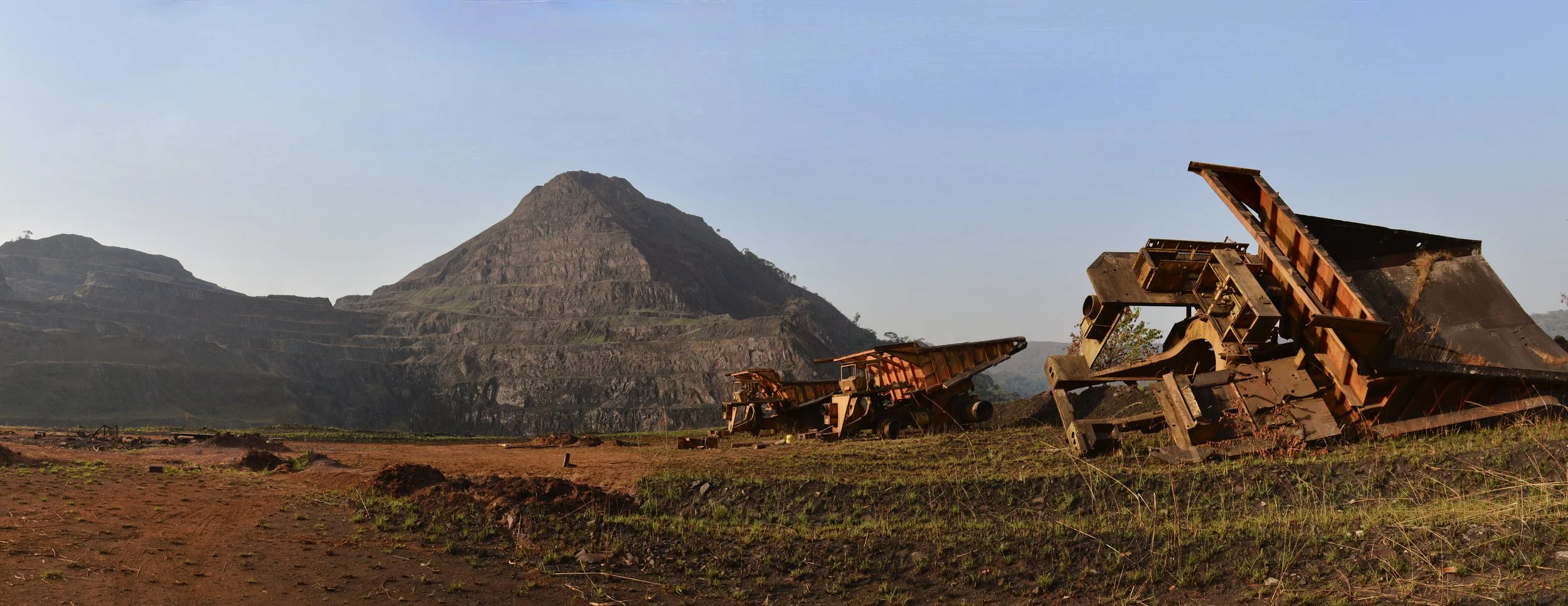
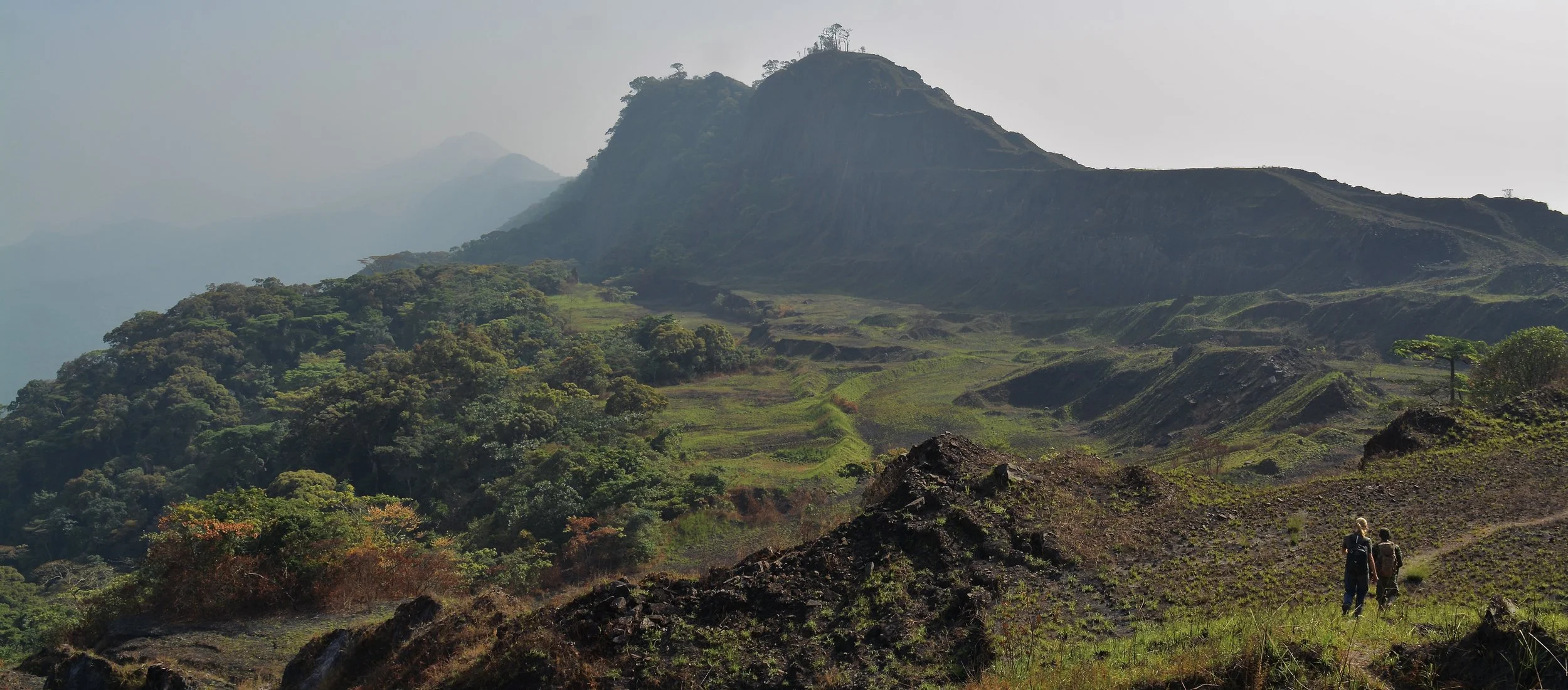
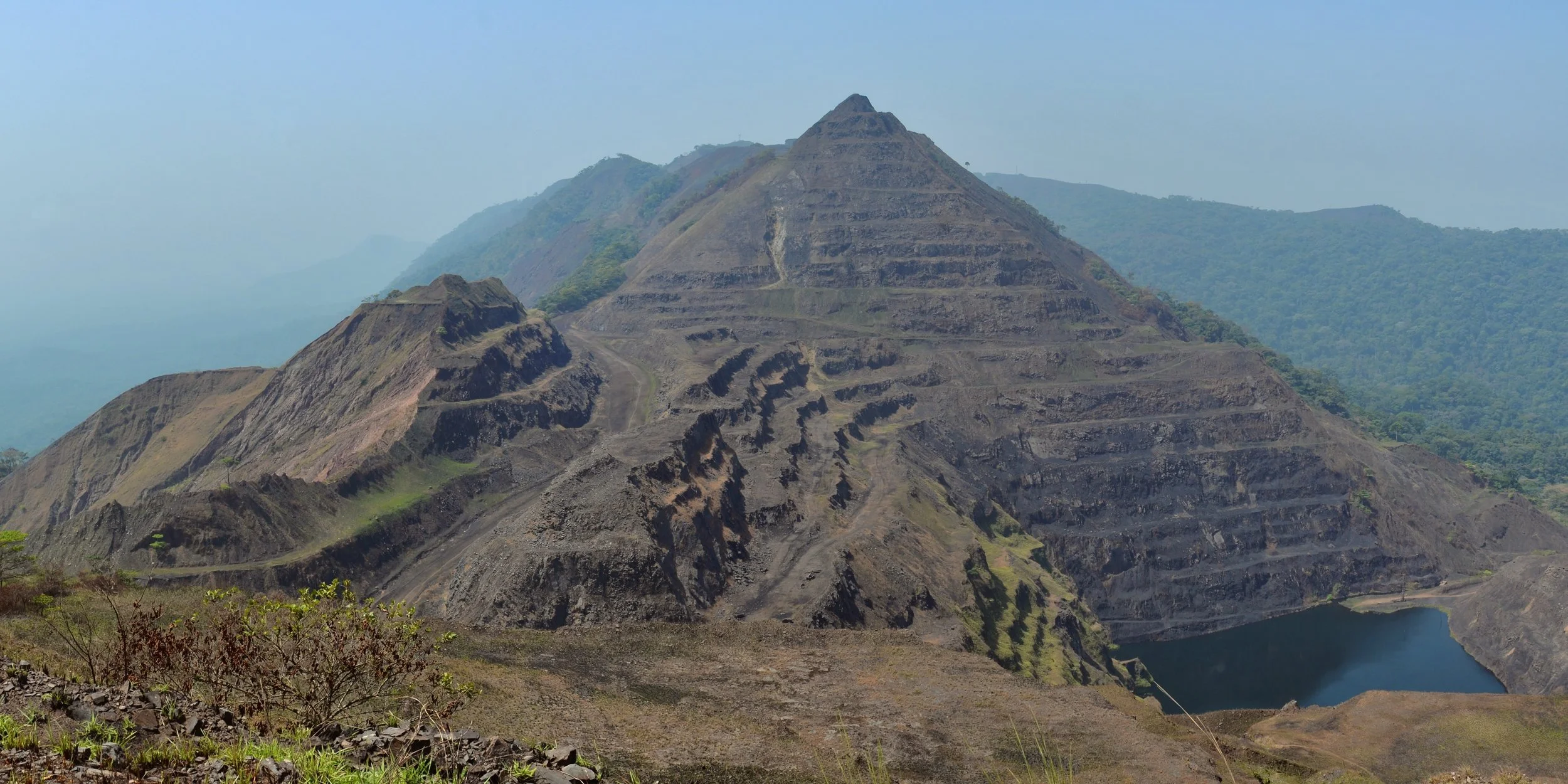
Finally the trees fell away and the mountain showed its wound. We passed the pit of an old iron ore cleaning facility, dropping deep into the ground. Far below, enormous pieces of machinery sat exactly where they were abandoned. The rusted frames of excavators and conveyors half-swallowed by shadow. Above, trucks the size of small houses lay on their sides showing years of being dismantled as locals took the scrap.
Past the pit, the route tightened again and further up, the view of an artificial lake appeared, its surface flat and unmoving. The scale was unsettling.
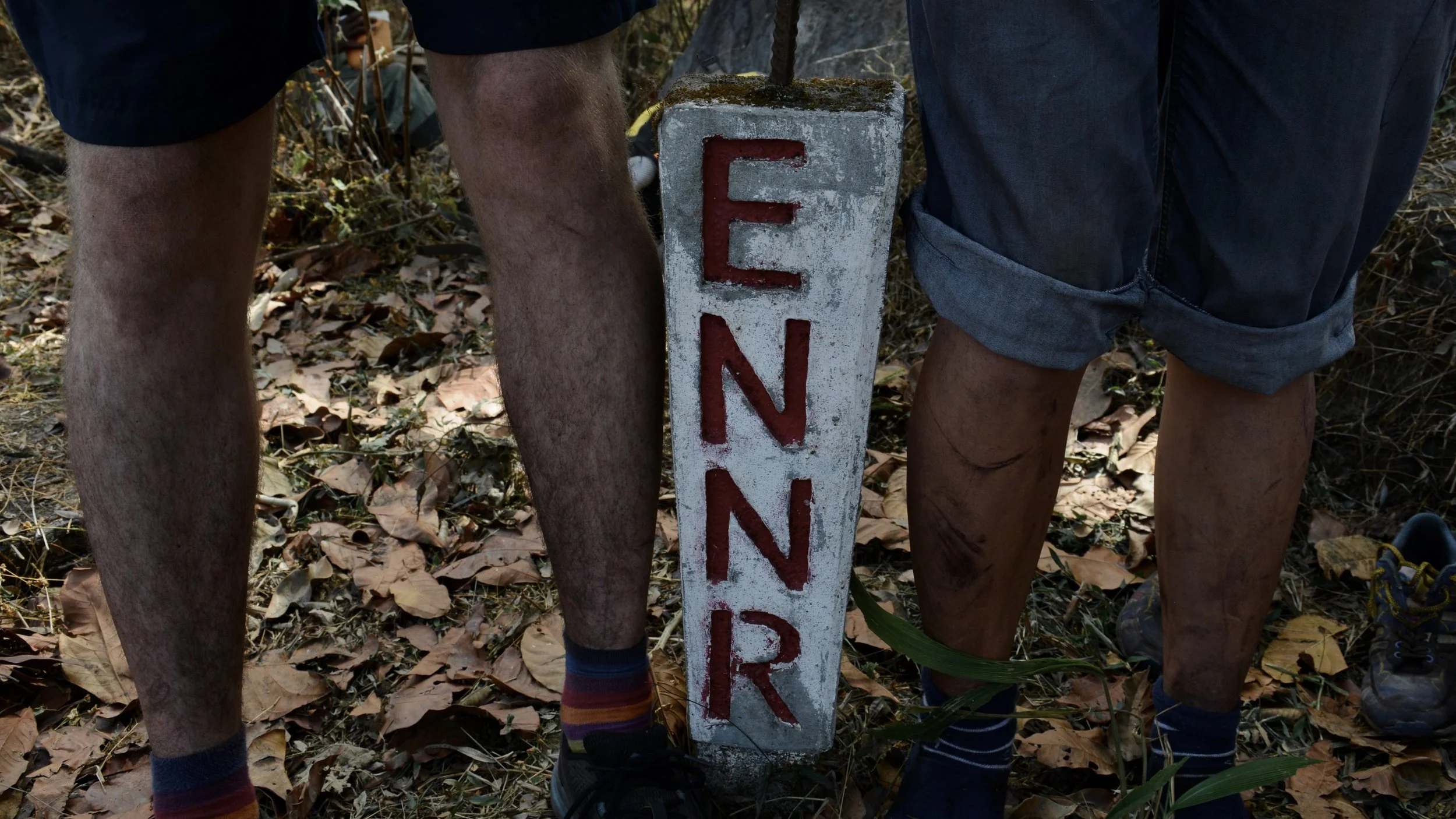
The trail eventually thinned to a rough line along the rocky and uneven ridge. Lizards scattered across the warm stone and tough plants clinging to the exposed ground. Our legs were coated in fine red iron-ore dust, worked into our skin by hours of brushing past the rock and scrub of the old mine. The forest broke and let the view through, a stunning panorama of folded hills stretching away into Liberia, Guinea, and Côte d’Ivoire.
Liberia was easy to enjoy by not expecting everything to happen on schedule. Eventually we found ourselves working with the rhythm rather than against it and neither Robertsport nor Nimba demanded much beyond a little flexibility. Robertsport makes an easy escape for a few days by the coast, while Nimba feels a world away in the rainforest. If you carry a little cash and keep an extra day in hand where possible, both destinations repay the effort. Leaving space for the unexpected is where we found Liberia offerings its best.